Songs of Peace: “Bulls on Parade”

Rage Against the Machine have many titles that could be picked for lists of the greatest protest songs. One of the most overtly antiwar tracks is “Bulls on Parade.” (1996).

Weapons not food, not homes, not shoes
Not need, just feed the war cannibal animal
I walk the corner to the rubble that used to be a library
Line up to the mind cemetery now
What we don’t know keeps the contracts alive and movin’
They don’t gotta burn the books they just remove ’em
While arms warehouses fill as quick as the cells
Rally ’round the family, pockets full of shells


Other “Songs of Peace” in this series:

November is Peace Month at your School Library

Louis Riel

On this day in 1885, Louis Riel was hanged for High Treason by Canadian authorities. Riel was a Metis leader who led the resistance of his people against the Canadian government in the Red River Rebellion of 1869 and the North-West Rebellion of 1884. Few Canadians can come even close to Riel as a divisive figure in Canadian history. Riel was portrayed as an enemy of Canada by the government of John A. Macdonald, a view that was held by many anglophone Canadians for many years, and still by some today. On the other hand, Metis was a hero to the Metis, to indigenous people in general, and to many French Canadians, and anglophone Catholics. To them Riel represented those that would stand up against the elites whose vision of Canada was dominated by white people, English speakers, and Protestants of Anglo-Saxon heritage. Today more Canadians look favourably upon Riel, a complex figure whose life is entwined with so many problematic issues from Canada’s history that still challenge us today.


Find out more:


Songs of Peace: “Hero of War”


“Hero of War” is a 2009 song by the American band, Rise Against. Many of the most well known peace and antiwar songs that are most prominent in popular culture come from the 1960s and 1970s, particularly protest songs against the American war in Vietnam. However, there are also many other more recent songs that look critically at more contemporary wars, including the U.S. wars in Iraq and Afghanistan. Have a listen, and spend some time thinking about your response. What do antiwar songs, and songs of peace and alternatives to violence, have to say to us in 2023?


Other “Songs of Peace” in this series:

Kazuo Ishiguro

Nobel Prize winning author Kazuo Ishiguro was born on this day in 1954. Ishiguro was born in Japan, but moved to the U.K. with his parents when he was five years old. He grew up to become one of most critically acclaimed authors in the English language, winning a variety of prestigious awards including the Booker Prize in 1989 for his novel, The Remains of the Day, and, for his entire body of work, the Nobel Prize in Literature in 2017.


Find out more:

Songs of Peace: Ohio

One of the most famous and influential songs of the antiwar movement of the 1960s and early 1970s is “Ohio”, written by Neil Young and performed by Crosby, Stills, Nash and Young. So many aspects of youth counter-culture, protests against the Vietnam War, and deep divisions within American society came together tragically as four university students were shot dead, and nine more wounded, at Kent State University in Ohio when the National Guard opened fire against student protestors. Neil Young wrote “Ohio” in reaction to the tragedy at Kent State, and the song was released in June of 1970. It has grown to become known as one the anthems of protest and antiwar activism.


November is Peace Month at your School Library.


Other “Songs of Peace” in this series:

Songs of Peace: “Zombie”


“Zombie” by The Cranberries was released in 1994. Led by the late Dolores O’Riordan (1971-2018), The Cranberries were one of Ireland’s greatest alternative rock bands, especially during the 90’s.

Zombie is an anti-war song written to protest the ongoing violence of “The Troubles,” sectarian conflict in Ireland with its roots going back deep into Irish history and continuing to rear its ugly head even into the 1990’s.


Other “Songs of Peace” in this series:

Indigenous Peoples Collection

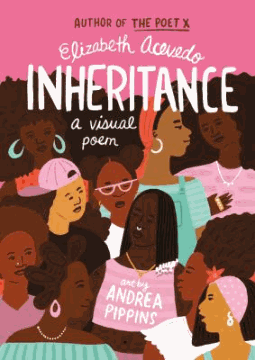
Come into the School Library to check out our newly established Indigenous Peoples Collection. This section of the School Library is devoted to titles from authentic indigenous writers.


All titles in the Indigenous Peoples Collection are designated with spine labels bearing the “IPC” prefix. Sublocations in the IPC include:
  • Coast Salish
  • Northwest Coast
  • First Nations
  • Inuit
  • Metis
  • Urban
  • Global
  • Own Voice
  • Truth and Reconciliation

and more…


June is National Indigenous History Month in Canada.