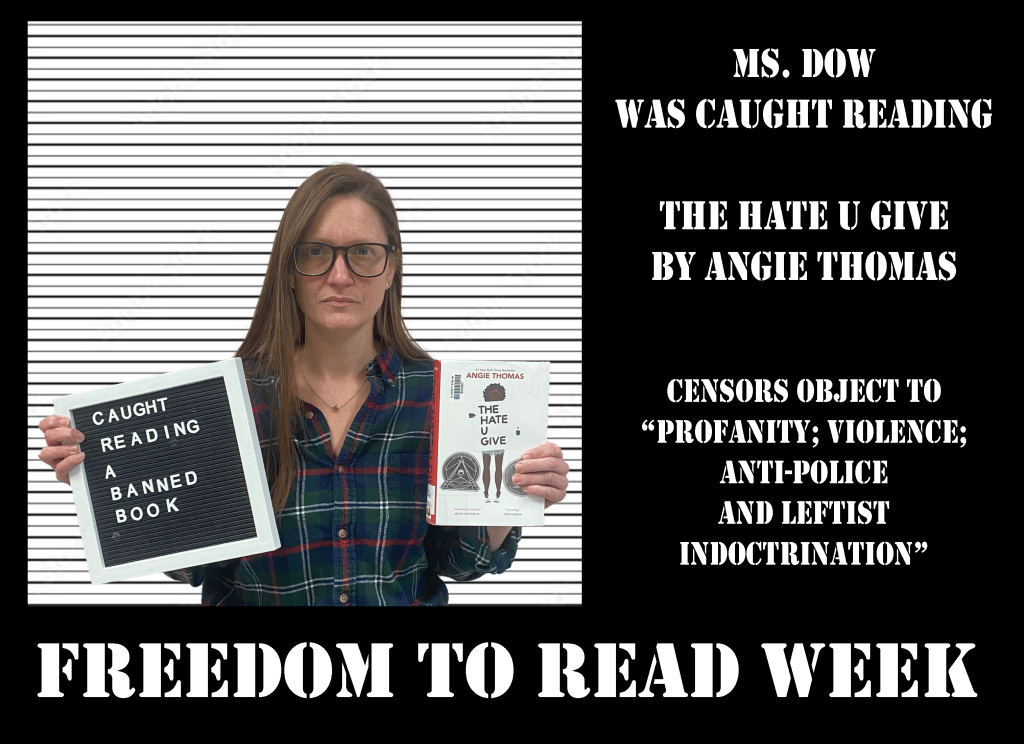
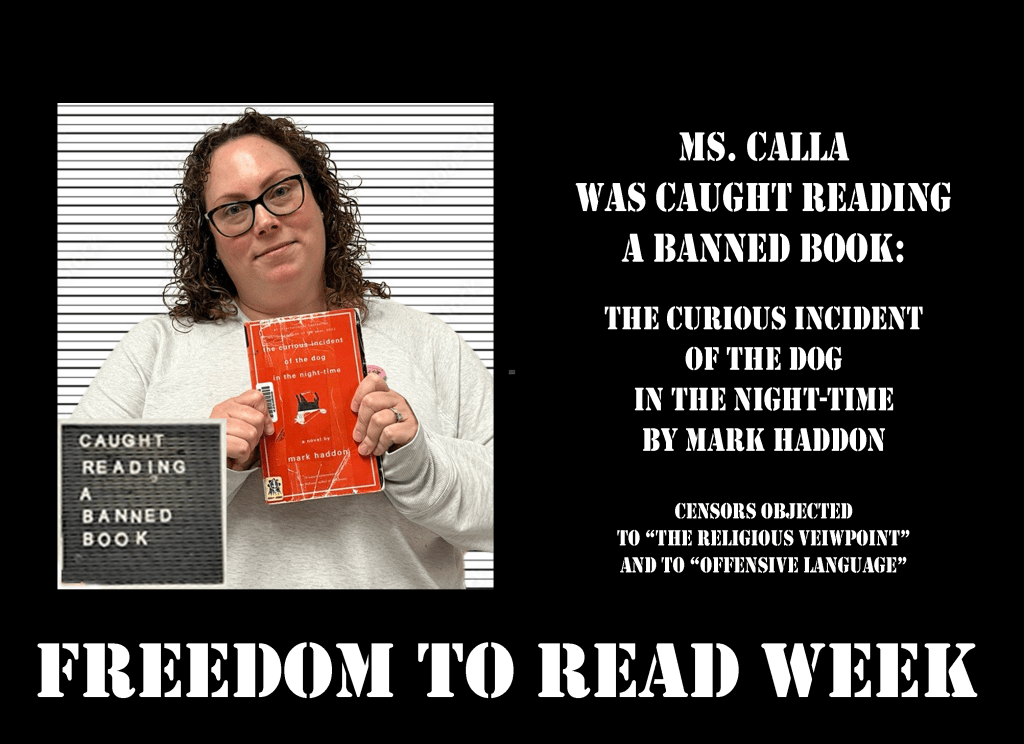
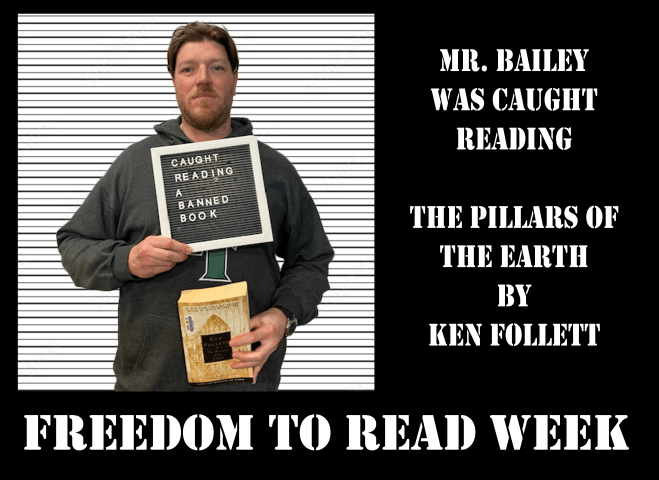
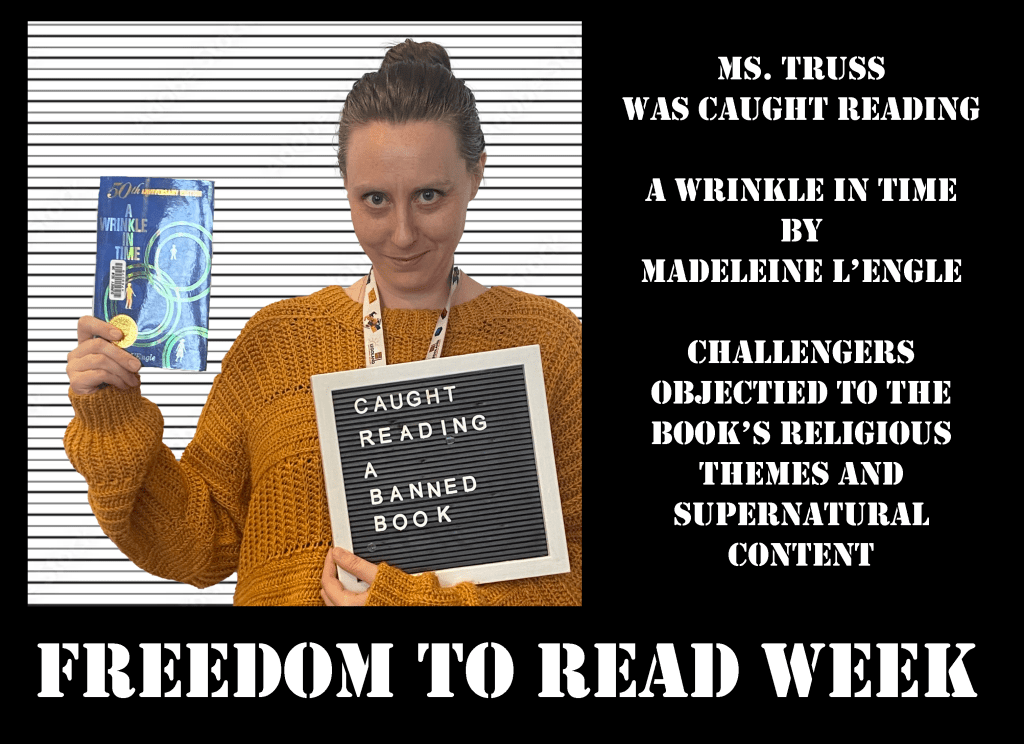
More teachers were caught reading banned books!
February 23 to March 1 is Freedom to Read Week in Canada
More teachers were caught reading banned books!


February 23 to March 1 is Freedom to Read Week in Canada
In the past few years, the number of challenges to books in both Canada and the United States has exploded. And while sanity prevails in many cases, in more and more places the censors have been successful. In some jurisdictions, hundreds and hundreds of different titles have been pulled from libraries, schools, government offices and other public institutions. In the private sector, bookstores and publishers have reported the increasing pressures of censorship. Writers have commented on the chilling effect this has on intellectual freedom.
Stand up for your rights and freedoms. Democracy is built on upon your right to information. You have the right to choose for yourself.
Adults have the right to choose for themselves what they want to read. Adults don’t have the right to choose what other people get to read. Parents have the right– and the responsibility– to teach and guide and discuss with their children about what types of library materials are right or wrong for them. Parents are free to have their opinions on what materials are good or bad for children in general They even have the right to express their opinions about why they think certain materials are good or bad for children. Parents do not have the right to decide for other people’s children what they can or can’t read.
February 23 to March 1 is Freedom to Read Week in Canada
February 23 to March 1, 2025, is Freedom to Read Week in Canada

From freedomtoread.ca: “Freedom to Read Week provides an opportunity for Canadians to focus on issues of intellectual freedom as they affect your community, your province or territory, our country, and countries around the world. Whether you are a librarian, bookseller, educator, student, or member of the community, there are lots of ways you can help mark this annual event.”
Visit your school library in person, or online here at tweedsmuirlibrary.ca, all week long to find out more about Freedom to Read in Canada, how you can celebrate, and how you can join in the ongoing struggle to protect your rights and freedoms.

From September 2022 to the end of August 2023, Canadian libraries, especially school libraries, faced the highest number of book challenges ever for a 12 month period in Canada (source). The number of official challenge is likely just a small fraction of the challenges that go unreported– ALA studies suggest 82 -97% of challenges go unreported (source).
Intellectual freedom has been a pillar of library philosophy for nearly a century; and in our current climate, it is perhaps our most valuable tool in our efforts to amplify the voices of the most marginalized within our communities.
Michael Nyby
Read the full article, “A Rising Tide of Censorship: Recent Challenges in Canadian Libraries” by Michael Nyby of the CFLA Intellectual Freedom Committee, at Freedomtoread.ca
Do you believe that you should be able to choose what you read? Or should other people be able to decide for you what you can read? Freedom to Read Week celebrates our fundamental freedoms as citizens of democracies and our fundamental rights as human beings. Freedom to Read Week also asks to to beware of the forces at work which erode and seek to destroy your rights and freedoms.


Do you take your Freedom to Read for granted? These are books that are available in our libraries which have been challenged, and in far too many cases, removed from shelves, and banned. Many of the books pictured here are on the list of the top 20 most banned books in the U.S. for the 2021-2022 school year.


This isn’t just happening in authoritarian states such as North Korea, Iran, China or Russia. This is happening in the so-called free world. This is happening in the United States. So far it hasn’t been as bad in Canada, but challenges are growing here and there are too many who want American censorship to come to Canada.


Find out more:
Banned in the USA: The Growing Movement to Censor Books in Schools

Join with us at your School Library as we observe and celebrate Freedom to Read Week in Canada, February 19-25, 2023.
Democracy is under attack in the world, and sadly, even here in Canada. Your democratic rights and freedoms as citizens in this country are built upon concepts such as voting rights; the rule of law; the equality of all people; freedom of thought, including political and religious beliefs; the freedom of the press; balancing government of the majority with protection of the rights of the minority; and more.
This week we celebrate and explore the freedom to read, which is interconnected with many other vital concepts, including freedom of expression, the the right to choose to read what you want to read, including access to information, the freedom to seek, use and share information and literature, all of which are integral to democratic citizenship.

Stereotypically, the library is seen as a quiet place, silent even, where not much happens. Yet the library, and especially the school library, has always been a target of censorship, and as such has always been in the middle of the ongoing struggle between democracy and the forces of authoritarianism. School libraries are now battlegrounds at the center of our current polarized political and cultural climate.
The recent news has been rife with reports of book challenges, book bannings– and terrifyingly, even book burnings– in many U.S. states, school districts, and school libraries. As Canadians we cannot assume that this is only an American problem. We must be vigilant in protecting our students’ freedom to read.
Freedom of expression rights are essential to education in a free and democratic society. These are the rights of everyone in the school community, including students. Teacher-librarians are charged with ensuring that those rights are acknowledged and respected.
Diane Oberg
Some students are fortunate enough to have many places to turn to for books and other sources of information. Collections at home, public libraries, books stores, and of course, the internet(!). However, access to those things may be very limited, censored, or non-existent for some students. The school library is often the safest and most accessible place for a wide variety of books and other sources of information that are relevant and essential for students.
All Canadians who value democracy have an interest in protecting and building up the institutions that support democracy. The school library is one of those institutions.
Read more about the vital role of the Teacher Librarians and of the school library play in protecting and empowering a student’s Freedom to Read:
“Freedom of Expression Rights and the School Library: Who Speaks for the Kids in Your School When the Censor Comes Calling?” by Diane Oberg (from FreedomtoRead.ca)


Find out more. Here are some informative and thought provoking articles on the freedom to read, censorship, book banning and free access to information:


Do you see any common themes amongst all these books?
These are just some of the books that have been challenged, banned and removed from school libraries in the USA, just this year. The freedom to read what you want to read is a fundamental cornerstone of democracy. However, just as democracy itself is under siege around the world, the freedom to read cannot be taken for granted. Anti-democratic forces are always at work to undermine your freedom to read and other democratic rights. You must stand up for those rights.
Is it a coincidence that the books seen above deal with themes such as discrimination, racism, and oppression, or have central characters that come from marginalized groups?
What do you think?
Find out more: FreedomtoRead.ca

Look for more on Freedom to Read Week in your School Library starting February 22. Meanwhile, be sure to enjoy Family Day on the 21st!
February 20-26 is Freedom to Read Week in Canada.
While this is always an important week on the calendar, this year it seems more vital than ever that we understand and celebrate our freedom to read. South of the border books are being banned at an alarming rate. Throughout the world, the freedom of journalists continues to be threatened. As authoritarian and fascist movements rise around the globe, they attack such things as libraries, a free press, and other cornerstones of democracy and human rights.

Look for more to come on this vital topic, as we prepare for Freedom to Read Week.
As Freedom to Read Week comes to an end, it bears considering that the freedom to read means nothing if citizens don’t exercise that that freedom.
“The man who does not read has no advantage over the man who cannot read.”
Source: Unknown*
The rights and freedoms of Canadians include the right to read what you want to read. Such rights and freedoms are fundamental to democracy. Yet there are forces at work in our society that seek power by attaching your rights, including attempts to censor or limit your freedom to read.
Authoritarian forces and totalitarian states know that uneducated and illiterate citizens are easier to control and oppress. Such forces can only celebrate that the work is much simpler when significant portions of the population choose not to read. Censorship becomes less pressing when “aliteracy” becomes prevalent.
A true democracy guarantees fundamental rights and freedoms to its citizens. But to work effectively, indeed, to survive, democracy requires that citizens exercise those rights. In particular, democracy breaks down if citizens aren’t educated, informed and active.
The rise of powerful new information technology in the last few decades has made it more important than ever that citizens are highly “information literate.” Citizens must not only have access to information, they must have the tools required to wade through increasingly destructive levels of misinformation, disinformation, propaganda, and outright lies. Citizens need to have access to information that is credible, accurate and trustworthy.
The rise of anti-intellectualism and anti-science movements, perhaps most recently represented by anti-vax conspiracies, are part of the wider breakdown of democratic institutions. There is little doubt that attacks on public education over many years have reaped some these results and are integral to the rise of authoritarianism.
It is not enough to celebrate the Freedom to Read. As citizens of democratic societies, we have an obligation to exercise our Freedom to Read, in part so that we are equipped to defend our democratic rights and freedoms.
It is clear that democracy is under attack, throughout the world, and in our back yard. We must act.

Note* The above quote, or variations on it, are often popularly attributed to Mark Twain. However the original source of this quote, or its variations, remains unclear.