Winter Solstice & Yule

The Winter Solstice for 2024 will occur on December 21 at 1:19 AM

Why are there so many Holidays and Holy Days at this time of year? Why do so many of them, especially in the Northern Hemisphere, seem to emphasize light, especially light in contrast to the darkness? Likely this is because of the Winter Solstice.

Stonehenge, a Celtic monument built for the Solstices, perhaps as much as 5000 years ago.
source: wikimedia commons/Mark Grant/(CC BY 2.5)

The longest night of the year. The shortest day. The Winter Solstice occurs on December 21 (in some years December 22) as the North Pole reaches its maximum tilt away from the sun. The North Pole will experience continuous darkness, the Polar region near total darkness, and the northern hemisphere its shortest day and longest night. Winter begins. Most populations will experience the darkest and coldest time of year.

It is a time where people crave light and warmth, and so it seems natural that the feasts and festivals of December emphasize those things. Moreover, at the darkest moment, hope is renewed, as after the solstice the days will get longer. This is hope for more light, more warmth. Spring will come eventually. New birth. New life.

And so many different observances, feasts, and festivals emereged at this time of the year, many on the day of the Solstice, and others near to it on the calendar.

  • Yule: Celtic Europe, Scandinavia and Germanic peoples.
  • Mean Geimhreadh: Irish
  • Alban Arthan: Wales
  • Modranhit: Anglo-Saxon Europe
  • Korochun: Slavic Eastern Europe
  • Shalako, Soyal :Native American peoples
  • Yalda: Iran/Persians
  • Dongzhi: China & East Asia
  • Lohri & Maghi: India, especially the Punjab
  • Dies Natalis Solis Invicti, Brumalia & Saturnalia: Ancient Rome

Of course, we have spent the last few weeks observing the many holidays and holy days of this time of year. It is not a coincidence that celebrations such as Christmas and New Year have grown to be huge events in the western world, and by extension other cultures, as the west has extended its influence around the globe. In places where modern conveniences such as lighting and heating offset the effect of the cold and dark of December, we might overlook how important it was for our ancestors to hope for the seeming death of one year to turn into the life of a new year, and to celebrate such rebirth.

Find out more:


Peace

November is Peace Month at your School Library. Learn more about peace and alternatives to war. Explore non-violence, pacifism, conscientious objectors, anti-war movements, civil disobedience, peacemakers, non-aggression, reconciliation, and other topics related to the pursuit of peace.


IPC

Come down to the School Library to check out our Indigenous Peoples Collection. As we observe Truth and Reconciliation Week here at Lord Tweedsmuir, what better time than now to take advantage of some of the excellent resources in our collection to learn more about this history and the current issues around Truth and Reconciliation?

Truth and Reconciliation Week

Lord Tweedsmuir Secondary School observes Truth and Reconciliation Week September 23 to 27, in preparation for the National Day for Truth and Reconciliation on Monday, September 30. Join with us in the school library to find out more.

International Day of Peace

September 21 is the International Day of Peace, also known as World Peace Day.

The International Day of Peace was established by the United Nations to be observed every year on September 21.

From the UN: “This year marks the 25th anniversary of the United Nations General Assembly’s adoption of the Declaration and Programme of Action on a Culture of Peace… In that declaration, the United Nations’ most inclusive body recognized that peace “not only is the absence of conflict, but also requires a positive, dynamic participatory process where dialogue is encouraged and conflicts are solved in a spirit of mutual understanding and cooperation.” … The International Day of Peace has always been a time to lay down weapons and observe ceasefires. But it now must also be a time for people to see each other’s humanity. Our survival as a global community depends on that.”


Find out more:

United Nations International Day of Peace

International Day of Peace.org

UNESCO

International Literacy Day 2024

source: UNESCO

September 8 is International Literacy Day. Literacy brings us joy and is a vital force for human rights, health, dignity and prosperity. Join with us in your School Library as we join with billions of people all over the planet in celebrating literacy and in standing together for the cause of improving literacy for all people.

From UNESCO:

Since 1967, the annual celebrations of International Literacy Day (ILD) have taken place on 8 September around the world to remind policy-makers, practitioners, and the public of the critical importance of literacy for creating more literate, just, peaceful, and sustainable society. 

Literacy is a fundamental human right for all. It opens the door to the enjoyment of other human rights, greater freedoms, and global citizenship. Literacy is a foundation for people to acquire broader knowledge, skills, values, attitudes, and behaviours to foster a culture of lasting peace based on respect for equality and non-discrimination, the rule of law, solidarity, justice, diversity, and tolerance and to build harmonious relations with oneself, other people and the planet. In 2022, however, at least one out of seven adults aged 15 and above (754 million) lacked basic literacy skills. Additionally, millions of children are struggling to acquire minimum levels of proficiency in reading, writing and numeracy, while some 250 million children of 6-18 years old are out of school. 

Read more from UNESCO


Juneteenth

Also known by such names as Freedom Day and Jubilee Day, Juneteenth is a celebration of the end of slavery after the end of the American Civil War.

source: amny.com

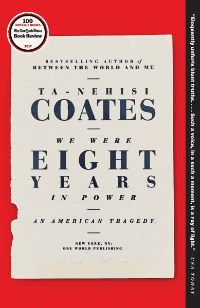
Juneteenth has grown to be a day that is observed in the US and around the world, as it symbolizes not only the fight against the evil that is slavery, but also the fight against racism in all its forms. Slavery finally came to end in the US in 1865, but racism lies at the heart of so many of the evils that still haunt the United States, Canada, and indeed, humanity. Current issues such as Black Lives Matter, Critical Race Theory, are all just part of the ongoing and centuries old struggle against racism.
Find out more about Juneteenth:

source: mosaictemplars.com

Yom HaShoah

Yom HaShoah, or Holocaust Remembrance Day, is the day that Jews around the world remember the six million who perished in the Holocaust.  In Israel it is a national day of observance known officially as Yom Hazikaron laShoah ve-laG’vurah, in English “Holocaust and Heroism Remembrance Day.” In addition to remembrance of the unspeakable horrors of the Holocaust, the day is also used to celebrate acts of resistance and heroism on the part of survivors and allies.
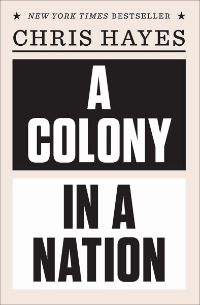
This year Yom HaShoah begins on the evening of May 5 and continues until sundown on May 6.


Find out more about the Holocaust, the systematic mass-murder of more than 6 million Jews, and other groups, targeted by the Nazis and their allies:

World Press Freedom Day

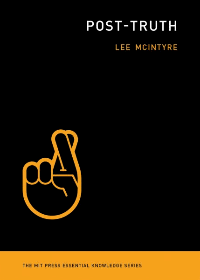
May 3rd is World Press Freedom Day, as established by UNESCO / United Nations. The freedom of the press is essential to the establishment and health of democracy.  In our world of social media, misinformation, disinformation, fake news and conspiracy theories, more than ever we need a free, independent, professional and ethical press.

source: UNESCO

Find out more:


Earth Month: What Does Science Say?

Earth Month comes to a close but the end of April does not mean the end of the climate crisis. Find out more. Find out what science says about climate change. Consider what you can do, as a citizen of this planet. Earth is the only planet we have. Consider what we, the people of Earth, can do, together, to save our home.


Find out more:

Intergovernmental Panel on Climate Change

United Nations: Climate Action

Canada Climate Change

(US) National Oceanic and Atmospheric Administration

What is Climate Change (UK Met)

NASA Scientific Consensus