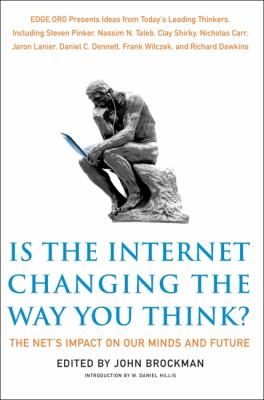
 Thought provoking ideas from a wide variety of thinkers are brought together by editor John Brockman in Is the Internet Changing the Way You Think? In the opening essay, “The Bookless Library,” Nicholas Carr asserts:
As a technology, a book focuses our attention, isolates us from the myriad distractions that fill our everyday lives. A networked computer does precisely the opposite. It is designed to scatter our attention. It doesn’t shield us from environmental distractions; it adds to them. The words on a computer screen exist in a welter of contending stimuli.
Carr isn’t arguing that the internet is bad. We cannot dispute that the internet has given us huge advantages. However, those advantages come at a cost.
My own reading and thinking habits have shifted dramatically since I first logged on the Web fifteen years ago or so. I now do the bulk of my reading and researching on-line. And my brain has changed as a result. Event as I’ve become more adept at navigating the rapids of the Net, I have experienced a steady decay in my ability to sustain my attention… What the Net seems to be doing is chipping away my capacity for concentration and contemplation.
The computer age has not rendered the book obsolete. True, the future of paper publishing may be in doubt. The physical book is here for at least the short-term. In the long run maybe they will be completely replaced by e-books. That is not the point. Regardless of the format, we need books, more than ever. We need them for many reasons, not least as an antidote to the distracted, shallow thinking that is the product of so much of what people do on-line. We need long-form text, including fiction and non-fiction. We need to read things that require concentration, engagement and deep thinking.
 Lord Tweedsmuir Secondary School Library