Winter Solstice & Yule

The Winter Solstice for 2025 will occur on December 21 at 7:03 AM

Why are there so many Holidays and Holy Days at this time of year? Why do so many of them, especially in the Northern Hemisphere, seem to emphasize light, especially light in contrast to the darkness? Likely this is because of the Winter Solstice.
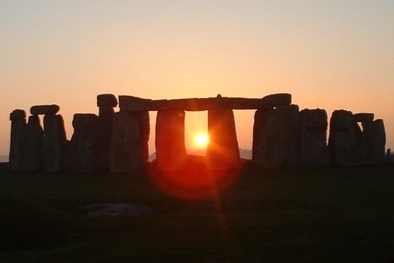
Stonehenge, a Celtic monument built for the Solstices, perhaps as much as 5000 years ago.
source: wikimedia commons/Mark Grant/(CC BY 2.5)

The longest night of the year. The shortest day. The Winter Solstice occurs on December 21 (in some years December 22) as the North Pole reaches its maximum tilt away from the sun. The North Pole will experience continuous darkness, the Polar region near total darkness, and the northern hemisphere its shortest day and longest night. Winter begins. Most populations will experience the darkest and coldest time of year.

It is a time where people crave light and warmth, and so it seems natural that the feasts and festivals of December emphasize those things. Moreover, at the darkest moment, hope is renewed, as after the solstice the days will get longer. This is hope for more light, more warmth. Spring will come eventually. New birth. New life.

And so many different observances, feasts, and festivals emereged at this time of the year, many on the day of the Solstice, and others near to it on the calendar.

  • Yule: Celtic Europe, Scandinavia and Germanic peoples.
  • Mean Geimhreadh: Irish
  • Alban Arthan: Wales
  • Modranhit: Anglo-Saxon Europe
  • Korochun: Slavic Eastern Europe
  • Shalako, Soyal :Native American peoples
  • Yalda: Iran/Persians
  • Dongzhi: China & East Asia
  • Lohri & Maghi: India, especially the Punjab
  • Dies Natalis Solis Invicti, Brumalia & Saturnalia: Ancient Rome

Of course, we have spent the last few weeks observing the many holidays and holy days of this time of year. It is not a coincidence that celebrations such as Christmas and New Year have grown to be huge events in the western world, and by extension other cultures, as the west has extended its influence around the globe. In places where modern conveniences such as lighting and heating offset the effect of the cold and dark of December, we might overlook how important it was for our ancestors to hope for the seeming death of one year to turn into the life of a new year, and to celebrate such rebirth.

Find out more:


The Holiday Season 2025

Here are just some of the observances, festivals, celebrations and special days that take place in the coming month or so of holidays and holy days, known to many as “The Holiday Season.”

  • November 30: Advent (first Sunday)
  • December 1: Gita Jayanti
  • December 2: Giving Tuesday
  • December 5: Krampusnacht
  • December 6: St. Nicholas Day
  • December 7: Advent (second Sunday)
  • December 8: Bodhi Day / Rohatsu
  • December 8: Feast of the Immaculate Conception
  • December 10: International Human Rights Day
  • December 11: Feast of Masa’il
  • December 14: Advent (third Sunday)
  • December 14 (evening): Hanukkah begins
  • December 16: Simbang Gabi / Los Posadas
  • December 21: Winter Solstice / Yule / Grianstad an Gheimhridh
  • December 21: Advent (fourth Sunday)
  • December 22: Hanukkah concludes
  • December 23: Festivus
  • December 24: Christmas Eve
  • December 25: Christmas Day
  • December 26: St. Stephen’s Day
  • December 26: Kwanzaa begins
  • December 31: New Year’s Eve
  • December 31: Hogmanay
  • January 1: New Year’s Day
  • January 1: Kwanzaa concludes
  • January 5: Guru Gobind Singh Jayanti
  • January 5: 12th Night / Christmastide concludes
  • January 6: Epiphany / King’s Day
  • January 7: Orthodox Christmas
  • January 13: Yule (First Full Moon after Solstice)
  • January 13: Maghi / Lohri

Visit your School Library, in person and online, to find out more about this season of Holidays and Holy Days.

Holidays & Holy Days


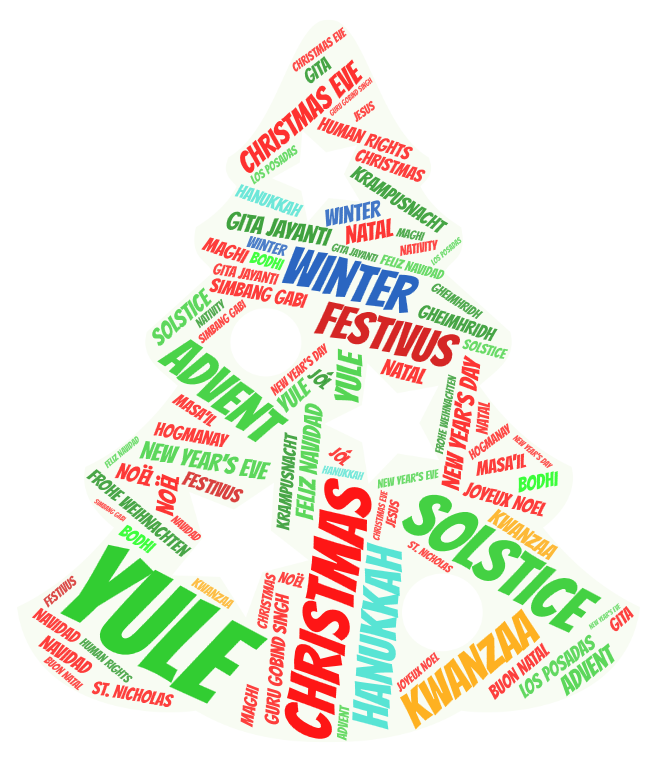
Happy Holidays! We have entered another season of feasts and festivals, holy days and holidays, in and around December. Visit your School Library, in person or online, to learn more about Christmas, Hanukkah, Kwanzaa, Yule, St. Nicholas Day, Simbang Gabi, Festivus, the Nativity, the Winter Solstice, Krampusnacht, New Year’s Eve, Advent, Bodhi, Boxing Day and more.

Winter Solstice & Yule

The Winter Solstice for 2024 will occur on December 21 at 1:19 AM

Why are there so many Holidays and Holy Days at this time of year? Why do so many of them, especially in the Northern Hemisphere, seem to emphasize light, especially light in contrast to the darkness? Likely this is because of the Winter Solstice.

Stonehenge, a Celtic monument built for the Solstices, perhaps as much as 5000 years ago.
source: wikimedia commons/Mark Grant/(CC BY 2.5)

The longest night of the year. The shortest day. The Winter Solstice occurs on December 21 (in some years December 22) as the North Pole reaches its maximum tilt away from the sun. The North Pole will experience continuous darkness, the Polar region near total darkness, and the northern hemisphere its shortest day and longest night. Winter begins. Most populations will experience the darkest and coldest time of year.

It is a time where people crave light and warmth, and so it seems natural that the feasts and festivals of December emphasize those things. Moreover, at the darkest moment, hope is renewed, as after the solstice the days will get longer. This is hope for more light, more warmth. Spring will come eventually. New birth. New life.

And so many different observances, feasts, and festivals emereged at this time of the year, many on the day of the Solstice, and others near to it on the calendar.

  • Yule: Celtic Europe, Scandinavia and Germanic peoples.
  • Mean Geimhreadh: Irish
  • Alban Arthan: Wales
  • Modranhit: Anglo-Saxon Europe
  • Korochun: Slavic Eastern Europe
  • Shalako, Soyal :Native American peoples
  • Yalda: Iran/Persians
  • Dongzhi: China & East Asia
  • Lohri & Maghi: India, especially the Punjab
  • Dies Natalis Solis Invicti, Brumalia & Saturnalia: Ancient Rome

Of course, we have spent the last few weeks observing the many holidays and holy days of this time of year. It is not a coincidence that celebrations such as Christmas and New Year have grown to be huge events in the western world, and by extension other cultures, as the west has extended its influence around the globe. In places where modern conveniences such as lighting and heating offset the effect of the cold and dark of December, we might overlook how important it was for our ancestors to hope for the seeming death of one year to turn into the life of a new year, and to celebrate such rebirth.

Find out more:

The Holiday Season

Here are just some of the observances, festivals, celebrations and special days that take place in the coming month or so of holidays and holy days, known to many as “The Holiday Season.”

  • December 1: Advent
  • December 3: Giving Tuesday
  • December 5: Krampusnacht
  • December 6: St. Nicholas Day
  • December 8: Bodhi Day / Rohatsu
  • December 8: Feast of the Immaculate Conception
  • December 8: Advent (second Sunday)
  • December 10: International Human Rights Day
  • December 11: Gita Jayanti
  • December 12: Feast of Masa’il
  • December 15: Advent (third Sunday)
  • December 16: Simbang Gabi / Los Posadas
  • December 21: Winter Solstice / Yule / Grianstad an Gheimhridh
  • December 22: Advent (fourth Sunday)
  • December 23: Festivus
  • December 24: Christmas Eve
  • December 25: Christmas Day
  • December 25 (evening): Hanukkah begins
  • December 26: St. Stephen’s Day
  • December 26: Kwanzaa begins
  • December 31: New Year’s Eve
  • December 31: Hogmanay
  • January 1: New Year’s Day
  • January 1: Kwanzaa concludes
  • January 2: Hanukkah concludes
  • January 7: Orthodox Christmas
  • January 13: Maghi
  • January 17: Guru Gobind Singh Jayanti

Winter Solstice

The Winter Solstice for 2023 will occur on December 21 at 7:27 PM

Why are there so many Holidays and Holy Days at this time of year? Why do so many of them, especially in the Northern Hemisphere, seem to emphasize light, especially light in contrast to the darkness? Likely this is because of the Winter Solstice.

Stonehenge, a Celtic monument built for the Solstices, perhaps as much as 5000 years ago.
source: wikimedia commons/Mark Grant/(CC BY 2.5)

The longest night of the year. The shortest day. The Winter Solstice occurs on December 21 (in some years December 22) as the North Pole reaches its maximum tilt away from the sun. The North Pole will experience continuous darkness, the Polar region near total darkness, and the northern hemisphere its shortest day and longest night. Winter begins. Most populations will experience the darkest and coldest time of year.

It is a time where people crave light and warmth, and so it seems natural that the feasts and festivals of December emphasize those things. Moreover, at the darkest moment, hope is renewed, as after the solstice the days will get longer. This is hope for more light, more warmth. Spring will come eventually. New birth. New life.

And so many different observances, feasts, and festivals emereged at this time of the year, many on the day of the Solstice, and others near to it on the calendar.

  • Yule: Celtic Europe, Scandinavia and Germanic peoples.
  • Alban Arthan: Wales
  • Modranhit: Anglo-Saxon Europe
  • Korochun: Slavic Eastern Europe
  • Shalako, Soyal :Native American peoples
  • Yalda: Iran/Persians
  • Dongzhi: China & East Asia
  • Lohri & Maghi: India, especially the Punjab
  • Dies Natalis Solis Invicti, Brumalia & Saturnalia: Ancient Rome

Of course, we have spent the last few weeks observing the many holidays and holy days of this time of year. It is not a coincidence that celebrations such as Christmas and New Year have grown to be huge events in the western world, and by extension other cultures, as the west has extended its influence around the globe. In places where modern conveniences such as lighting and heating offset the effect of the cold and dark of December, we might overlook how important it was for our ancestors to hope for the seeming death of one year to turn into the life of a new year, and to celebrate such rebirth.

Find out more:

Summer Solstice

Tomorrow is the first day of Summer. The Summer Solstice will take place in the Northern Hemisphere at 7:57 AM on June 21st (Pacific Daylight Time). The Summer Solstice is also called the estival solstice and occurs in the Northern Hemisphere when the North Pole is at its most extreme tilt towards the sun. The result is the longest day (and shortest night) of the year. The Solstice is also the first day of the season of Summer– although, confusingly, festivals known as Midsummer, take place around the same time, often on June 24.

By Bengt Nyman from Vaxholm, Sweden – DIMG_5456, CC BY 2.0,

Winter Solstice

The Winter Solstice will occur on December 21 at 1:47 PM

Why are there so many Holidays and Holy Days at this time of year? Why do so many of them, especially in the Northern Hemisphere, seem to emphasize light, especially light in contrast to the darkness? Likely this is because of the Winter Solstice.

Stonehenge, a Celtic monument built for the Solstices, perhaps as much as 5000 years ago.
source: wikimedia commons/Mark Grant/(CC BY 2.5)

The longest night of the year. The shortest day. The Winter Solstice occurs on December 21 (in some years December 22) as the North Pole reaches its maximum tilt away from the sun. The North Pole will experience continuous darkness, the Polar region near total darkness, and the northern hemisphere its shortest day and longest night. Winter begins. Most populations will experience the darkest and coldest time of year.

It is a time where people crave light and warmth, and so it seems natural that the feasts and festivals of December emphasize those things. Moreover, at the darkest moment, hope is renewed, as after the solstice the days will get longer. This is hope for more light, more warmth. Spring will come eventually. New birth. New life.

And so many different observances, feasts, and festivals emereged at this time of the year, many on the day of the Solstice, and others near to it on the calendar.

  • Yule: Celtic Europe, Scandinavia and Germanic peoples.
  • Alban Arthan: Wales
  • Modranhit: Anglo-Saxon Europe
  • Korochun: Slavic Eastern Europe
  • Shalako, Soyal :Native American peoples
  • Yalda: Iran/Persians
  • Dongzhi: China & East Asia
  • Lohri & Maghi: India, especially the Punjab
  • Dies Natalis Solis Invicti, Brumalia & Saturnalia: Ancient Rome

Of course, we have spent the last few weeks observing the many holidays and holy days of this time of year. It is not a coincidence that celebrations such as Christmas and New Year have grown to be huge events in the western world, and by extension other cultures, as the west has extended its influence around the globe. In places where modern conveniences such as lighting and heating offset the effect of the cold and dark of December, we might overlook how important it was for our ancestors to hope for the seeming death of one year to turn into the life of a new year, and to celebrate such rebirth.

Find out more:

Winter Solstice

Why are there so many Holidays and Holy Days at this time of year? Why do so many of them, especially in the Northern Hemisphere, seem to emphasize light, especially light in contrast to the darkness? Likely this is because of the Winter Solstice.

Stonehenge, a Celtic monument built for the Solstices, perhaps as much as 5000 years ago.
source: wikimedia commons/Mark Grant/(CC BY 2.5)

The longest night of the year. The shortest day. The Winter Solstice occurs on December 21 (in some years December 22) as the North Pole reaches its maximum tilt away from the sun. The North Pole will experience continuous darkness, the Polar region near total darkness, and the northern hemisphere its shortest day and longest night. Winter begins. Most populations will experience the darkest and coldest time of year.

It is a time where people crave light and warmth, and so it seems natural that the feasts and festivals of December emphasize those things. Moreover, at the darkest moment, hope is renewed, as after the solstice the days will get longer. This is hope for more light, more warmth. Spring will come eventually. New birth. New life.

And so many different observances, feasts, and festivals emereged at this time of the year, many on the day of the Solstice, and others near to it on the calendar.

  • Yule: Celtic Europe, Scandinavia and Germanic peoples.
  • Alban Arthan: Wales
  • Modranhit: Anglo-Saxon Europe
  • Korochun: Slavic Eastern Europe
  • Shalako, Soyal :Native American peoples
  • Yalda: Iran/Persians
  • Dongzhi: China & East Asia
  • Lohri & Maghi: India, especially the Punjab
  • Dies Natalis Solis Invicti, Brumalia & Saturnalia: Ancient Rome

Of course, we have spent the last few weeks observing the many holidays and holy days of this time of year. It is not a coincidence that celebrations such as Christmas and New Year have grown to be huge events in the western world, and by extension other cultures, as the west has extended its influence around the globe. In places where modern conveniences such as lighting and heating offset the effect of the cold and dark of December, we might overlook how important it was for our ancestors to hope for the seeming death of one year to turn into the life of a new year, and to celebrate such rebirth.

Find out more:


The Winter Solstice and Yule (December 21)

source: Wikimedia Commons / CC

The days of Fall grow shorter and shorter, and in the Northern Hemisphere the month of December is dark and cold. The low point is the Winter Solstice, December 21st, the shortest day of the year.

In traditional pagan cultures, this time of the year represented the battle between darkness and light, between life and death.  Death and darkness seem to be winning through this season. On the Solstice, the dark and cold had reached its nadir. Henceforth the days would grow longer and warmer. The darkness gives way to light, and death gives way to life. Hope is restored.

Many of the festivals and celebrations that take place at this time of year, from many different cultures, follow this theme.  Yule was celebrated by many peoples of northern pre-Christian Europe, including the Celts, and such Germanic groups as the Angles, Saxons, Danes and Norse.  Like many of the pagan holidays, Yule was adapted by Christian Europe and incorporated into Christmas traditions. However, followers of neopagan religions, such as Wicca, have re-established Yule as a distinct celebration.

Find out more:

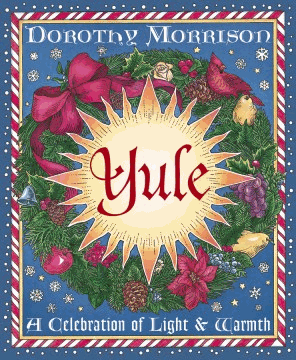
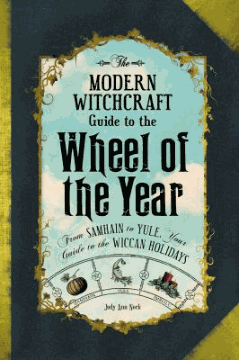
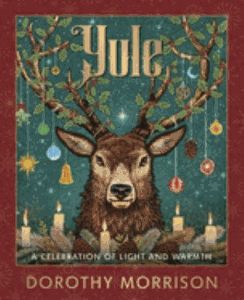
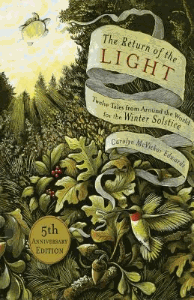
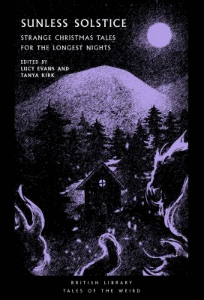
For more on this and other winter observances and feasts, check out our display, “Holidays and Holy Days,” and books such as: