Surrey Teens Read: Better Than the Movies by Lynn Painter
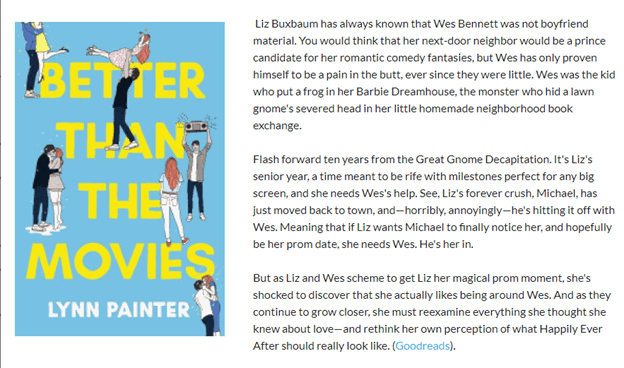
Come down to your School Library to check out Lynn Painter’s Better Than the Movies, one of this year’s ten nominated titles from Surrey Teens Read.
Surrey Teens Read: Better Than the Movies by Lynn Painter
Come down to your School Library to check out Lynn Painter’s Better Than the Movies, one of this year’s ten nominated titles from Surrey Teens Read.

All students, grades 8 to 12, boys and girls, are invited to join the LTSS Book Club at the very first meeting, September 29th at lunch in the Library.
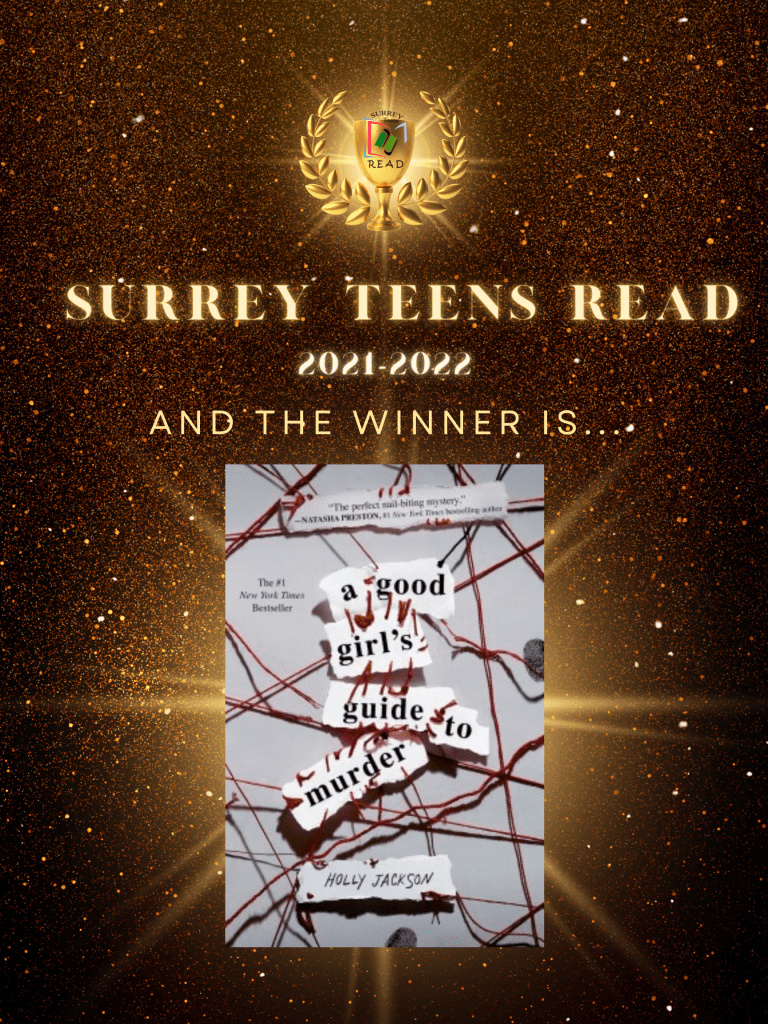
source: Surrey Teens Read
The high school students of Surrey have spoken. They have selected Holly Jackson’s a good girl’s guide to murder as the winner for Surrey Teens Read in 2022.
Thanks to all the students who voted, all the students who read the books, and to all the Teacher Librarians who make Surrey Teens Read happen.
As of today, 4/1/2022, all students and staff at Lord Tweedsmuir Secondary School, and throughout the district, are required by law to show proof of 5 doses of the Credulus Vaccine.
All 5 doses are injected simultaneously, with 1 directly into the eyeball, 1 underneath the thumbnail, 1 into your arm, 1 into the body part of your choice, and finally, 1 directly into the CENSORED.
Students or staff who fail to provide proof of vaccination will be prosecuted and could face up to 10 years in federal prison.
Madeleine Albright died on March 23, 2022.

Madeleine Albright was born in 1937 in Prague ( in what is now Czechia). Her family fled from both the Nazis and the Communists. The family first left the country after the German invasion of Czechoslovakia, returned after the end of the Second World War, only to flee again, this time from the Communists in 1948. Albright was a brilliant student who would go on to earn her PhD from Columbia University. She then served in both academic and government positions, providing expertise as a foreign policy advisor. In 1993 she became U.S. Ambassador to the United Nations. In 1997 she became Secretary of State, the first female to be appointed to that prestigious position in the U.S. Cabinet.
Madeleine Albright leaves many legacies from her life of academics and public service, including the book Fascism: A Warning.
The list of Surrey Teens Read nominees never fails to offer compelling reads. This week we look at They Went Left by Monica Hesse.
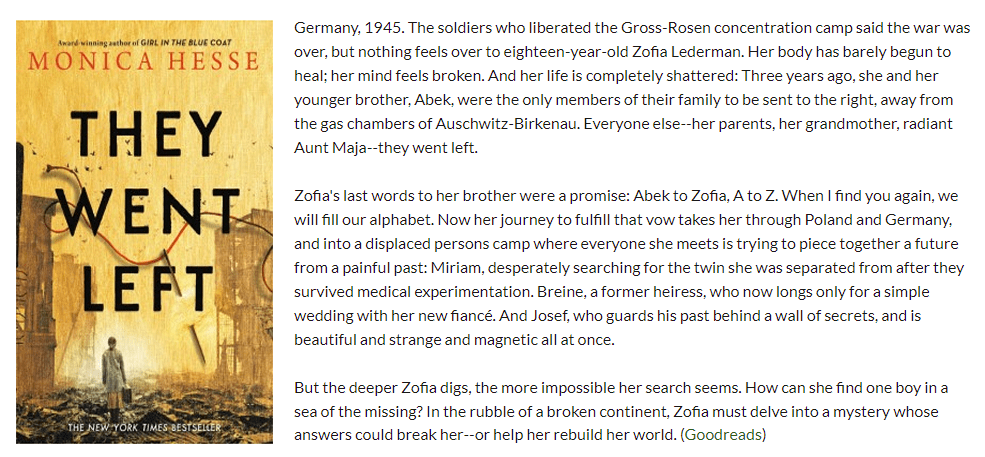
Come down to the School Library to see They Went Left and the other nine nominated titles for this school year’s version of Surrey Teens Read.
Find out more at surreyteensread.weebly.com
We aren’t even completely done with First Semester, yet here we are, already thinking about Second Semester. That’s just the way it goes in our school system.
We look forward to serving you in the Second Semester of the 2021-2022 School Year. If you haven’t already done so, please be sure to come check out the School Library and find out what we can do to help you as a student at Lord Tweedsmuir, as a lifelong learner, and as a reader!
This year’s list of Surrey Teens Read nominees is rife with compelling stories. This week we look at The Inheritance Games by Jennifer Lynn Barnes.
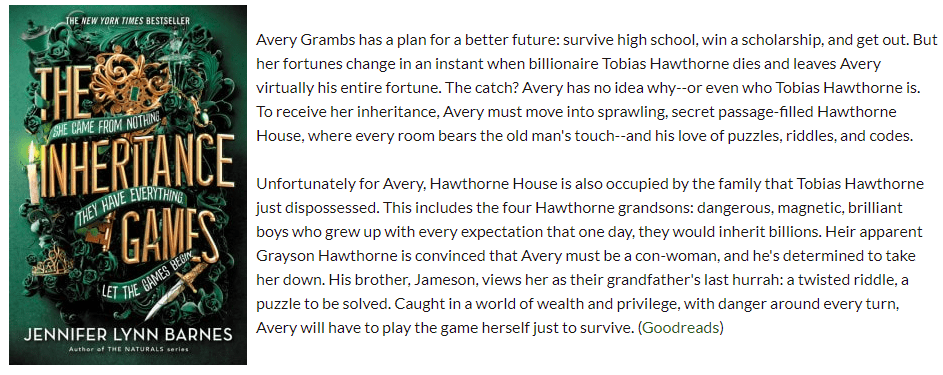
Come down to the School Library to see The Inheritance Games and the other nine nominated titles for this school year’s version of Surrey Teens Read.
Find out more at surreyteensread.weebly.com
This year’s list of Surrey Teens Read nominees has something for everyone. This week we look at None Shall Sleep by Ellie Marney.

Come down to the School Library to see None Shall Sleep and the other nine nominated titles for this school year’s version of Surrey Teens Read.
Find out more at surreyteensread.weebly.com
As always, this year’s list of Surrey Teens Read nominees is full of interesting reads. This week we look at The Brave by James Bird.

Come down to the School Library to see The Brave and the other nine nominated titles for this school year’s version of Surrey Teens Read.
Find out more at surreyteensread.weebly.com
Do you know that you can have school library books delivered to you in your classroom? If you haven’t done it before, it is easy to learn how!

1. Search for Tweedsmuir Library or use this URL : tweedsmuirlibrary.wordpress.com
2. Click on Catalog
3. Sign in with your School District username and password
4. Use the Catalog (Destiny Classic or Destiny Discover) to search for books
5. When you find a book, click on the title or on the “Details” button
6. Click the “Hold It” button
7. Expect an email to your Surrey Schools email address when the book is ready.
8. IF you don’t use your Surrey Schools email, you will need to use your regular email to contact tweedsmuirlibrary@gmail.com
9. When the book is ready, you can pick it up at the School Library OR you can have it delivered to your morning class.
Go here for a more detailed TEXT step-by-step guide.
Go here for an even more detailed ILLUSTRATED step-by-step guide.

Find out the latest information about the Covid19 pandemic:
Public Health Agency of Canada
CDC: Centers for Disease Control & Prevention (USA)

 Lord Tweedsmuir Secondary School Library