Mandela and Rugby

For the rugby players and fans of rugby football in our community, there is another compelling story related to the late Nelson Mandela. While soccer was a sport embraced by the black South African population, for most of the 20th century rugby was the sport of choice for white South Africans, so much so that very many blacks, rugby was a symbol of the racism and oppression of Apartheid. As much as anybody else, Nelson Mandela changed that. Mandela understood the importance of rugby to white South African culture. As he struggled to lead South Africa through the transition from Apartheid, Mandela understood that rugby might be a key factor in garnering support from the white community and perhaps even help step closer to the dream of a racially united “rainbow nation.” As South Africa prepared to host the 1995 World Cup of Rugby, Mandela became the Sprinboks’ number one fan. That the Boks went on to win the World Cup was the storybook ending. It was a truly memorable scene to witness Mandela, clad in his Springboks uniform, once a symbol of Apartheid, handing the Webb Ellis Cup to the Boks’ Captain, Francois Piennar.

To learn more about this fascinating intersection between sport, politics, culture and history, check out the following:
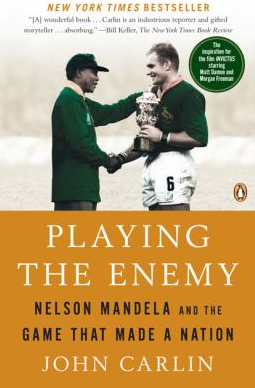
Screen Shot 2013-12-09 at 10.35.10 AMPlaying the Enemy by John Carlin (2008).


“Invictus,” a film (2009) by Clint Eastwood, starring Morgan Freeman as Nelson Mandela and Matt Damon as Springboks’ Captain Francois Piennar. Based on Playing the Enemy.


16th
source: ESPN.com

“The 16th Man,” an ESPN 30 For 30 documentary produced by Morgan Freeman.

Nelson Mandela 1918-2013

CC: South Africa The Good News / www.sagoodnews.co.za
source: Wikimedia Commons / CC

There are very few heroes left. It seems like we face a never-ending string of political scandals, resulting in a pervasive mistrust of and disrespect for our leaders. Pop culture gives us celebrities who, inevitably it seems, demonstrate increasingly destructive behaviour as they succumb to addiction and all the other pitfalls of “stardom.” Sports can offer some inspiration, but increasingly we are disillusioned with a world that seems overtaken by greed, cheating, unsportsmanlike behaviour, and violence. People who do really good things are too often ignored by a public fascinated with the ugly and the vapid.

Yesterday we lost a true hero.  

For those who don’t know his story, you must learn it. Nelson Mandela was the leading figure in the fight against the racist Apartheid regime of South Africa, the system which enabled the white minority to oppress the black majority for most of the 20th century.  Mandela was imprisoned for 27 years by the Apartheid government.  From his cell he grew into the symbolic leader of the struggle against Apartheid, and racism around the world. In 1990 he was released, as the government finally realized it had to change. The process led to the first multiracial elections in 1994. Mandela was elected President, a position he held until 1999.

There are many aspects of Mandela’s record and his character to admire. What stands out for me was forgiveness.  After having 27 years of his life stolen by his oppressors, Mandela might have used to his influence to lead the black majority in a bloody, violent quest for retribution against the whites.  Certainly there were many elements within the black community that called for that. Instead, Mandela called for peace, for forgiveness, for reconciliation. Mandela used his incredible influence, the amazing respect that he commanded, to unite the entire nation in a quest for a peaceful transition to a post-apartheid society. If anyone had a right to demand justice, to seek revenge, it may have been Mandela. Instead, he forgave. 

Like Martin Luther King Jr. and Gandhi before him, Mandela demonstrated the power of forgiveness, of non-violence and of reconciliation. As U2’s Bono described him, Mandela was a “lesson in grace.”

Nelson Mandela was just a man. He wasn’t perfect. He had his faults, both private and public. His greatness is demonstrated in the nearly universal respect he garnered, the esteem which he was held in by people all over the world, people of all races, religions, political leanings, wealth and social standing. This respect was built on his incredible example of forgiveness.