At Lord Tweedsmuir Secondary today we have our annual assemblies to observe Remembrance Day. We honour the memory of those Canadians who have fallen in war. We do not celebrate or glorify war, but we pay respect to those that have paid the terrible costs of war.
This coming weekend will be a long weekend for students, a chance for rest and However, it is important to remember that Remembrance Day is not one of the those holidays that is just an excuse for a long weekend. Please take some time over these next few days to reflect on what Remembrance Day is all about. And on Monday, plan to take some time to honour those that have died and those that have served. Whether you attend a ceremony in person, or check out the television coverage of the ceremony in Ottawa, take some time for Remembrance.
“The historic decision to include women in the legal definition of “persons” was handed down by Canada’s highest court of appeal – the Judicial Committee of the Privy Council of Great Britain – on October 18, 1929. This gave women the right to be appointed to the Senate of Canada and paved the way for women’s increased participation in public and political life.” (From Status of Women Canada: Persons Day.)
source: famous5ottawa.ca
It may seem incomprehensible to us that women were not considered to be “persons”, at least under a strict definition of Canadian law prior to 1929. The “Famous Five” led the fight all the way to the highest courts of the land to include women in the legal definition of “persons.”
“The exclusion of women from all public offices is a relic of days more barbarous than ours. And to those who would ask why the word “person” should include females, the obvious answer is, why should it not?”
Today we can celebrate that victory, and the slow but steady change in Canadian society towards equality for women. We still have a long way to go, and sadly, in much the world, women are still denied equality, a “relic of days more barbarous than ours.” Persons Day is a chance to celebrate how far we have come, and to reflect on how far we still need to go.
For those born in last few decades, the greatest goal in hockey that they ever witnessed was the “Golden Goal” of Sydney Crosby, the overtime goal which captured the Gold Medal for Canada at the 2010 Olympics in Vancouver.
For others, sandwiched between the baby boomers and the millennials, the greatest goal ever scored, that they saw, came in 1987, as Wayne Gretzky passed the puck to Mario Lemieux, who scored to give Canada a 6-5 victory over the Soviet Union in the third and deciding game of the Canada Cup.
The case can be made for other great goals as well. However, hockey fans in their 50’s or older were witnesses to “The Goal,” what most hockey observers, experts and fans alike, consider to be the greatest goal in hockey history.
In 1972 the Summit Series featured the stars of the NHL, Team Canada, against the Soviet Union. The series was about more than just hockey. It was the height of the cold war, and for many people, this was an extension of that conflict between Soviets, representing communism and totalitarianism, and the democratic, capitalist, “free” countries of the “West.”
1972 was the first time that the best players in professional hockey would be assembled to take on the Soviets, the powerhouse that had dominated international and Olympic hockey since the 1950’s. Canadians were confident that this time it would be different, as hockey was our game, and now we finally had a chance to prove it, “best on best.” For the first time we would send our best players, our NHL stars, to teach the Soviets about hockey.
It didn’t start out that way. The Canadian stars were used to using September to get in shape for the NHL season. They weren’t ready to play and it showed, as Canada only won one game out of the first four games at home, and then dropped the first game in Russia. Down 3 games to 1, with one tie, the Canadians needed to win the final three games in Russia to win the series. They would win the next two to even the series and make the 8th and final game the decider.
What had already been a dramatic series was about to achieve legendary status. Down by two goals going into the 3rd period, Canada clawed their way back to tie the game with about 7 minutes left. In the final minute, Paul Henderson scored to give Canada the lead and the victory in the series.
Canadians had been watching on their television sets, all over the country and around the world. Many Canadians can still tell you where they were when Henderson scored “The Goal.”
Asian Heritage Month gives Canadians of all ethnic and cultural backgrounds the opportunity to learn more about, and celebrate, the history of Asian Canadians and the contributions of Asian Canadians to the development of our nation. Canadians trace their roots to all corners of the globe, including such places as China, Japan, the Philippines, Korea, Vietnam and many more Asian nations.
A year ago today Canada lost one its greatest cultural icons and one of its fiercest patriots, as Stompin’ Tom Connors passed away at the age of 77. Best known for “The Hockey Song,” Stompin’ Tom wrote songs about all things Canadian.
source: stompintom.com
Besides “The Hockey Song” which can still be heard in arenas all over Canada, some of his other wonderful country-folk songs include “Bud the Spud,” “Sudbury Saturday Night,” and “Moon Man Newfie.” Tom Connors was born in 1936 in Saint John, New Brunswick. He travelled the country from sea to sea to sea, singing his songs and celebrating Canada and Canadians.
February 15 is Flag Day in Canada. On this day we celebrate the establishment of our red and white Maple Leaf flag in 1965. For most of Canada’s history, the Union Flag of the United Kingdom, the “Union Jack,” was official flag of our country, reflecting our status as a colony in the British Empire. After Confederation Canada would fly the “Red Ensign” with the Union Jack in the corner, as Canada began to assert its unique status as a Dominion within the Empire. The government sought to establish a new flag in the 1960′ to more fully reflect our independence and standing in the world. Many designs were considered. Ultimately the red Maple Leaf on the white and red flag won the day and is now amongst the most recognizable symbols in the world. For more on Flag Day:
Remember, Remembrance Day is not one of the those holidays that is just an excuse for a long weekend. Please take some time over these next few days to reflect on what Remembrance Day is all about. And on Monday, plan to take some time to honour those that have died and those that have served. Whether you attend a ceremony in person, or check out the television coverage of the ceremony in Ottawa, take some time for Remembrance.
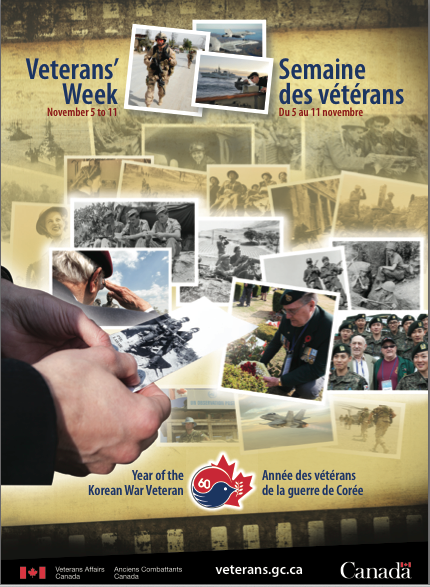
Each year, from November 5 to 11, hundreds of commemorative ceremonies and events will take place across the country to commemorate Veterans’ week. These are opportunities for all Canadians to recognize the contribution our Veterans have made and to honour those who made the ultimate sacrifice on behalf of Canada.
There are so many ways to remember and honour our Veterans:
Wear a poppy.
Attend your local Remembrance Day ceremony on November 11th.
Visit the remembrance challenge page where you will find videos and images you can use to create a mashup, build a virtual scrapbook, a fan site or just decorate your own Web space. Share what you build with others and link back to our site.
However you choose to remember Canada’s Veterans, be sure to share it with everyone you know. Together, it is our duty to pass on our gratitude and keep their legacy and memories alive. This Veterans’ Week, show you remember.
“The historic decision to include women in the legal definition of “persons” was handed down by Canada’s highest court of appeal – the Judicial Committee of the Privy Council of Great Britain – on October 18, 1929. This gave women the right to be appointed to the Senate of Canada and paved the way for women’s increased participation in public and political life.” (From Status of Women Canada: Persons Day.)
source: famous5ottawa.ca
It may seem incomprehensible to us that women were not considered to be “persons”, at least under a strict definition of Canadian law prior to 1929. The “Famous Five” led the fight all the way to the highest courts of the land to include women in the legal definition of “persons.”
“The exclusion of women from all public offices is a relic of days more barbarous than ours. And to those who would ask why the word “person” should include females, the obvious answer is, why should it not?”
Today we can celebrate that victory, and the slow but steady change in Canadian society towards equality for women. We still have a long way to go, and sadly, in much the world, women are still denied equality, a “relic of days more barbarous than ours.” Persons Day is a chance to celebrate how far we have come, and to reflect on how far we still need to go.
Canadian literary legend Alice Munro has been awarded the 2013 Nobel Prize in Literature. She is the first Canadian woman and first Canadian based author to win the award. Munro is considered to be a master of the short story and is often compared to Russian author Anton Chekov. She has previously won the Man Booker Prize, the Giller Prize and the Governor General’s Award.
Come down to the school library to check out some of her books.




 Munro is considered to be a master of the short story and is often compared to Russian author Anton Chekov. She has previously won the Man Booker Prize, the Giller Prize and the Governor General’s Award.
 Lord Tweedsmuir Secondary School Library